
Technology

The technology behind BoneScore®

Every other bone test looks at bone. BoneScore® touches it.

DXA, CT, and MRI infer bone health from images. They measure how much mineral is present, or what the structure looks like. Neither tells you how the bone tissue behaves when it is loaded — whether it resists a crack or lets one propagate.

OsteoProbe® answers that question directly. It presses a fine, sterile probe against the surface of the tibia and delivers a single, precisely controlled micro-impact. The bone’s resistance to that impact is measured in microns and converted into a score.

How it works

A very fine probe — about as thin as an acupuncture needle — is placed against the front of your shinbone. The area is numbed first with local anesthetic.

The probe gives one quick, gentle tap, and measures how much the bone pushes back.

The tap presses a dent into the surface of the bone, no bigger than a pencil point. Making that dent opens a few microscopic cracks — far finer than a grain of sand.

This is the whole point of the test.

Those tiny cracks are the same thing that happens, on a much larger scale, when a bone actually breaks. A break doesn’t start as a break. It starts as a small crack that keeps going.

In healthy bone, the protein and natural glue holding the bone together stretch and grab, absorbing the energy and stopping the crack almost immediately. The probe hits that resistance and stops.

The difference is thousandths of a millimeter — too small to feel, easy for the device to measure. The tap itself happens in less than a thousandth of a second.

Your doctor takes several readings a few millimeters apart, because bone isn’t perfectly uniform. Averaging them gives a more reliable answer than any single reading. The dents are microscopic, and your body repairs them on its own, the same way it handles the normal wear of everyday activity.
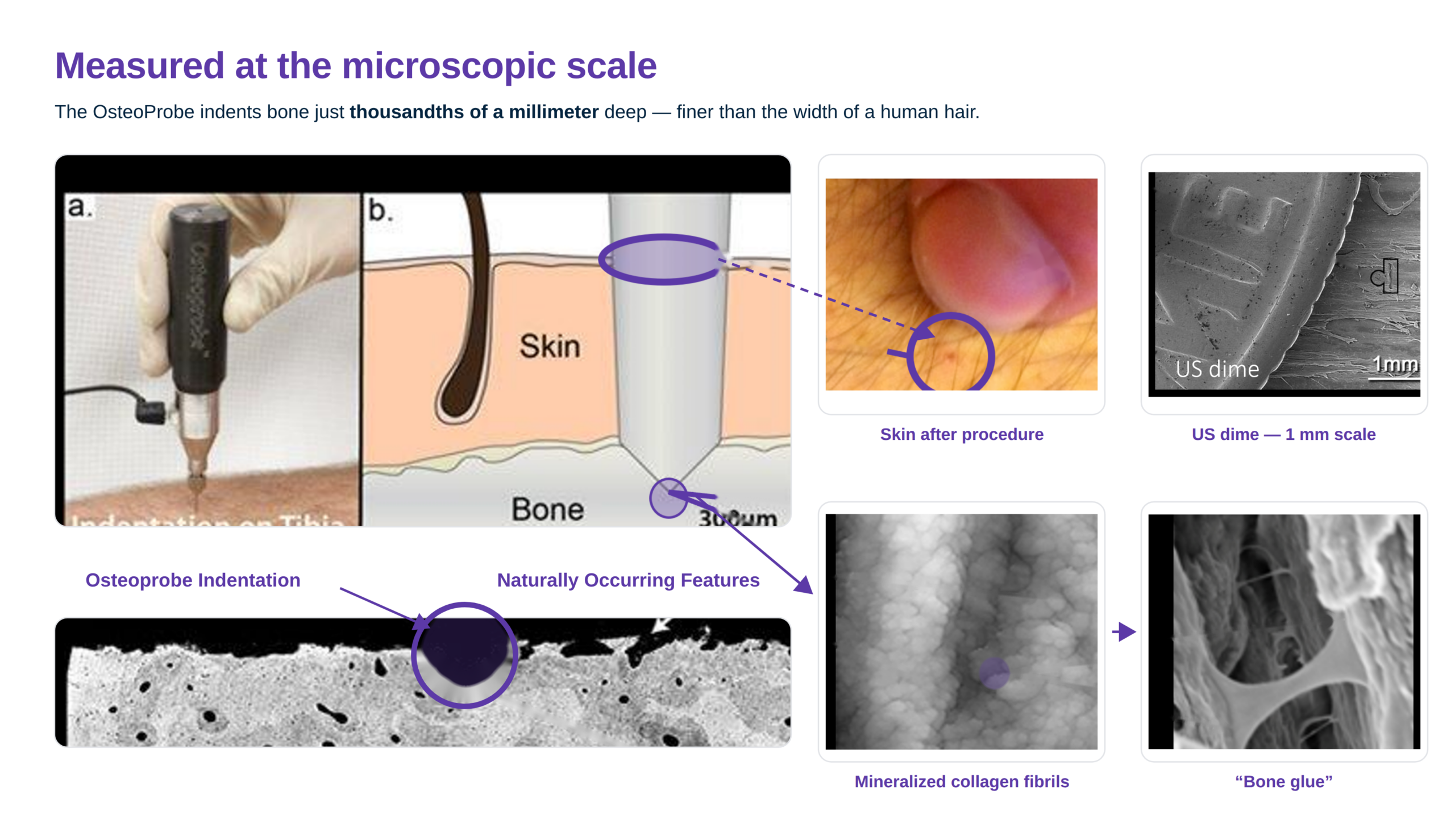
OsteoProbe indentation at microscopic scale: indentation on the tibia, mineralized collagen fibrils, bone glue, a US dime for scale, and skin after the procedure
Measured at the microscopic scale — the OsteoProbe indents bone just thousandths of a millimeter deep, finer than the width of a human hair.

Reading the scale

Scores run from about 40 to 100. Healthy adults typically land around 82.

The more the bone resists, the higher the BoneScore®. The less it resists, the lower the score.

Results are real-time and are provided on the screen right away.

This same measurement is called BMSi, short for Bone Material Strength index. It’s the scientific term for what BoneScore® reports.

~40100

Healthy adults typically land around 82.

Why your shin?

It’s a fair question. You’re unlikely to break your shinbone. So why measure there?

Because the answer travels with you.

Researchers put this to the test directly. They took bones from 67 donors — the shinbone plus the hip, wrist, and a spinal vertebra from each one. A BoneScore® reading was taken at the shin. Then the other bones were broken in a machine set up to recreate the way people actually fall: sideways onto the hip, forward onto an outstretched hand, and compression at the spine.

Bones from donors with higher shin readings took more force to break. The connection was clearest at the hip, close behind at the wrist and spine.1

Two findings stood out.

Adding the shin reading to a density scan nearly doubled how much of hip strength could be explained — from 28% using density alone to 52% using both together.

Among donors whose density scans looked normal or only mildly low, the shin reading still tracked with hip strength — and density didn’t.

References

  1. Vaidya RS, et al. Impact microindentation evaluates bone strength, bone quality, and fracture susceptibility across skeletal sites: a cadaver study. Clinical Orthopaedics and Related Research. 2026 (accepted). View source →
Scroll to Top