
The tech behind 200+ published studies
Cyclic and Impact microindentation has been used by independent research groups for over 2 decades to investigate bone material properties in vivo & ex vivo in animals and humans — across metabolic bone disease, endocrinology, orthopedics, exercise science, and pharmacology.
If you’re designing a study that needs a direct, repeatable measure of bone tissue quality, this page covers what the BioDent® & OsteoProbe® measure, how they have been used, and how to get a device of for your research.
What OsteoProbe® measures
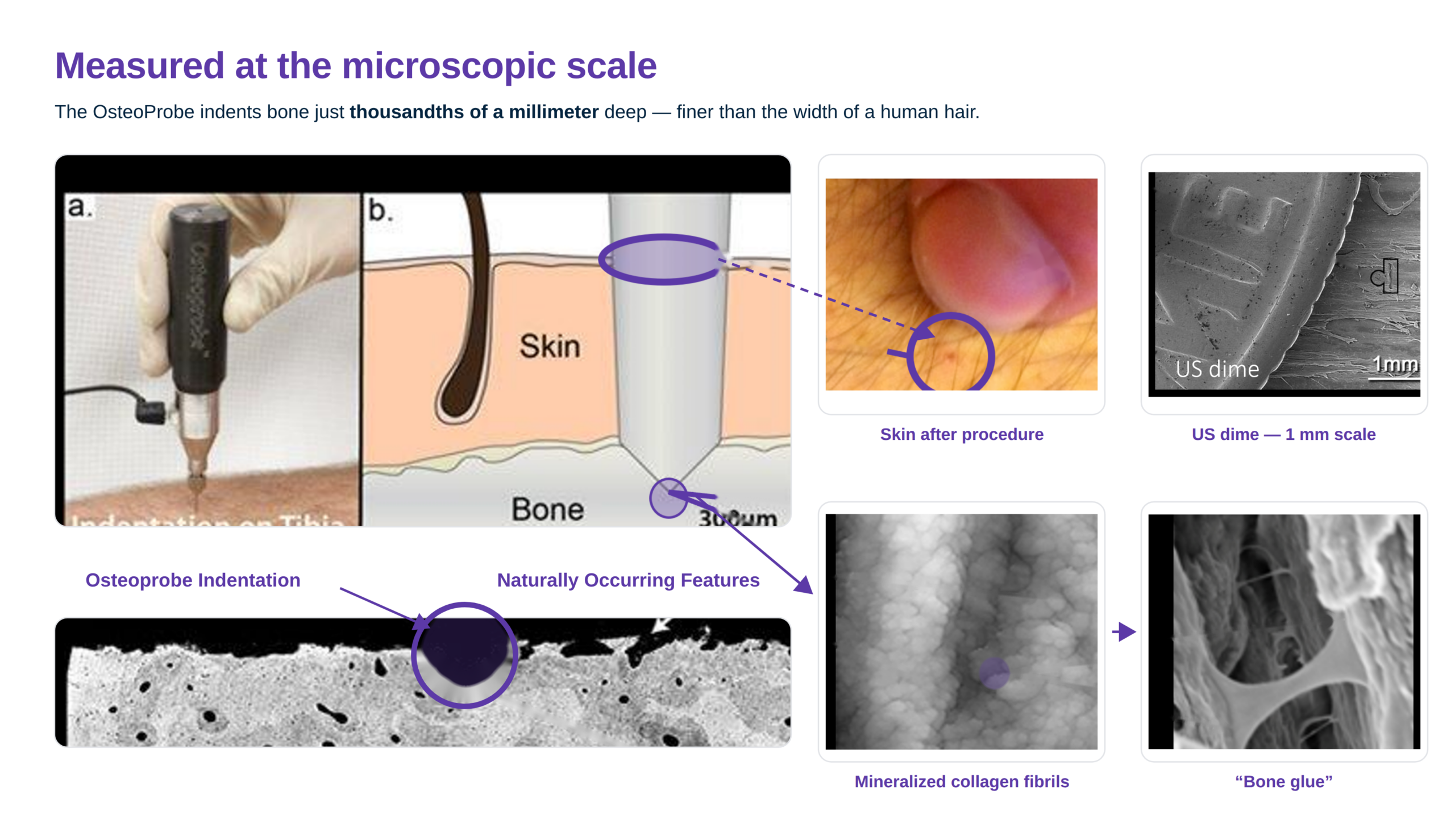
OsteoProbe® performs impact microindentation on the anterior tibial cortex and quantifies the tissue’s resistance to indentation. The output is the Bone Material Strength Index (BMSi) or BoneScore®.
Unlike densitometry or imaging-based methods, BMSi reflects the mechanical behavior of bone tissue itself rather than its mass, geometry, or microarchitecture — which makes it complementary to DXA, HR-pQCT, and QCT rather than duplicative.
Why it’s used in research
It measures a property other tools don’t
Studies pairing BMSi with HR-pQCT have found that BMSi changes occur independently of volumetric BMD and microarchitecture — it captures variance other instruments miss.It responds quickly
BMSi has shown measurable change within 7 weeks of pharmacological intervention and within 3 months of a mechanical loading intervention. For intervention studies, that shortens follow-up windows considerably.It’s radiation-free
No dosimetry constraints, no cumulative-exposure limits on repeat measures, and a simpler ethics pathway for longitudinal and healthy-volunteer designs.It’s portable
Handheld and battery-operated — usable in field studies, multi-site protocols, and populations that can’t easily travel to a scanner.Where it’s been applied
Recent work includes direct biomechanical validation against whole-bone strength and fracture toughness across multiple skeletal sites.1 Published work using impact microindentation spans:
- Metabolic bone disease — osteoporosis, atypical femoral fracture, fracture on therapy
- Secondary osteoporosis — type 1 and type 2 diabetes, glucocorticoid-induced, CKD, post-transplant, HIV
- Pharmacological intervention — bisphosphonates, teriparatide, denosumab, romosozumab
- Exercise and mechanical loading — high-impact training interventions
- Orthopedics — fixation, implant-related bone quality
- Comparative and preclinical — animal models and ex vivo work
Methodological considerations
We’d rather you design a good study than a fast one. A few things worth knowing up front:
- Measurement protocol matters. BMSi is sensitive to operator technique, probe placement, and the number of indentations averaged. Published protocols vary; we recommend reviewing the methodology of studies closest to your design before finalizing yours.
- Reference values are population-dependent. BMSi distributions differ by age, sex, and comorbidity. Control-group design matters more than an absolute cutoff.
- Cross-study comparison requires care. Differences in device generation, probe type, and protocol mean BMSi values aren’t always directly comparable between publications.
- The evidence base is largely associative. Most published work demonstrates group differences or intervention response, not prospective fracture prediction. If your study is powered for outcomes, that’s a genuine contribution to a real gap in the literature.
What we can support
Research pricing
On devices and consumables.
Training
On measurement protocol for study staff.
Protocol consultation
We’re happy to review a draft methods section.
Multi-site coordination
For distributed studies.
Literature support
Help identifying prior work relevant to your design.
Investigator-initiated studies
Proposals welcome.
Regulatory note for study designers
OsteoProbe is FDA-cleared (De Novo DEN210013; 510(k) K250216) as a measurement tool for assessing bone tissue resistance to microindentation at the tibia in adults, reported as BMSi.2 It is not cleared for diagnosing disease, predicting fracture risk, or guiding treatment.
For research use, your IRB will want the cleared indication and the current safety profile — both of which are available in our documentation package. Studies investigating uses beyond the cleared indication may require additional regulatory consideration.
Tell us about your study design
We’ll route you to the right resources — pricing, protocol guidance, or prior literature.
What BioDent™ measures
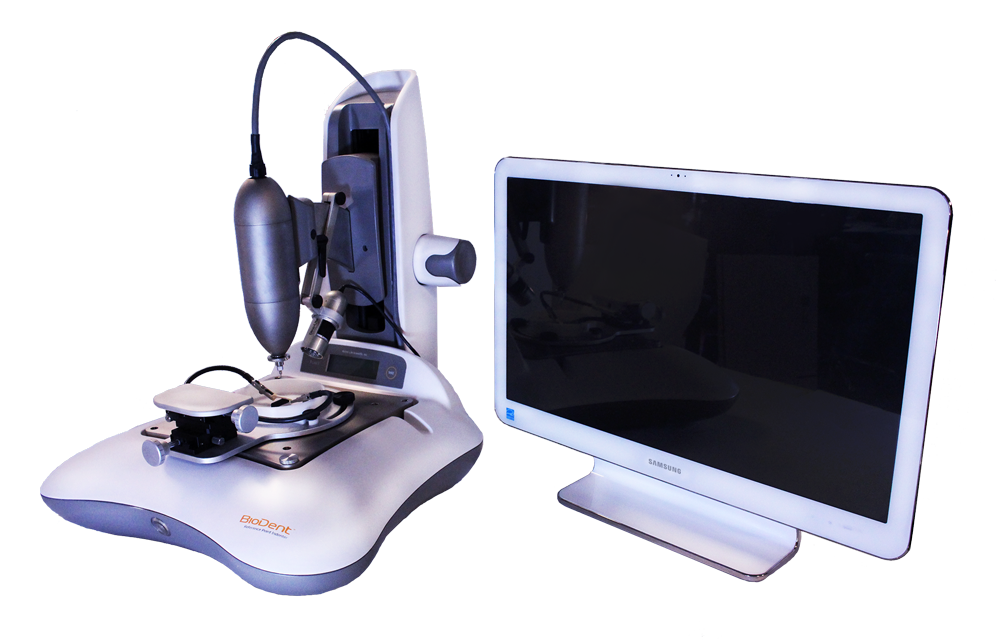
BioDent™ is a unique microindentation system designed to measure a wide range of tissue and material samples in vivo or ex vivo. It is a cyclic microindenter that captures complete force-displacement curves that can be analyzed to determine intrinsic mechanical properties, providing insights into bone quality:- Loading and Unloading Slopes: relative measures of material stiffness.
- Indentation Distances: relative measures of fracture resistance.
- Energy Dissipation: relative measure of material flexibility.
What makes BioDent™ different
BioDent and OsteoProbe are both based on Reference Point Indentation (RPI). RPI is a novel technology developed and solely distributed by Active Life Scientific, Inc. that directly assesses bone material quality and fragility in-vivo or in-situ.
Unlike imaging techniques that use radiation to measure the mineral content of bone (density and structure), RPI physically interacts with the tissue to measure how well the mineral and organic (collagen, non-collagenous proteins, etc.) function together.
This enables RPI to be sensitive to elements of bone strength that imaging techniques miss, like how mineralized collagen fibrils can dissipate energy without severing.
Why it’s used in research
Using the RPI principle, BioDent™ is a highly configurable bench-top platform that measures material properties at the tissue level by indenting a test probe into a material to record force and displacement data.
Typically, BioDent™ calculates 9 parameters related to the material properties of tissue or other relatively hard materials that reflect stiffness and energy dissipation of the tissue or material.
It can be used ex-vivo or in-vivo, for longitudinal measurements.
Laboratory animals are often sacrificed and assessed by 3- or 4-point bending techniques. These ex-vivo methods yield data on the stiffness, elasticity and maximum load of bones but are limited to one time point.
BioDent’s ability to measure animals in-vivo in a safe, minimally invasive manner allows for research opportunities that were previously not possible, as well as reduce the number of animals that are needed to complete a longitudinal study.
References
- Vaidya RS, et al. Impact microindentation evaluates bone strength, bone quality, and fracture susceptibility across skeletal sites: a cadaver study. Clinical Orthopaedics and Related Research. 2026 (accepted). View source →
- U.S. Food & Drug Administration. De Novo classification DEN210013; 510(k) K250216 (OsteoProbe). View source →
Tell us about your pre-clinical study design
We’ll route you to the right resources — pricing, protocol guidance, or prior literature.
